


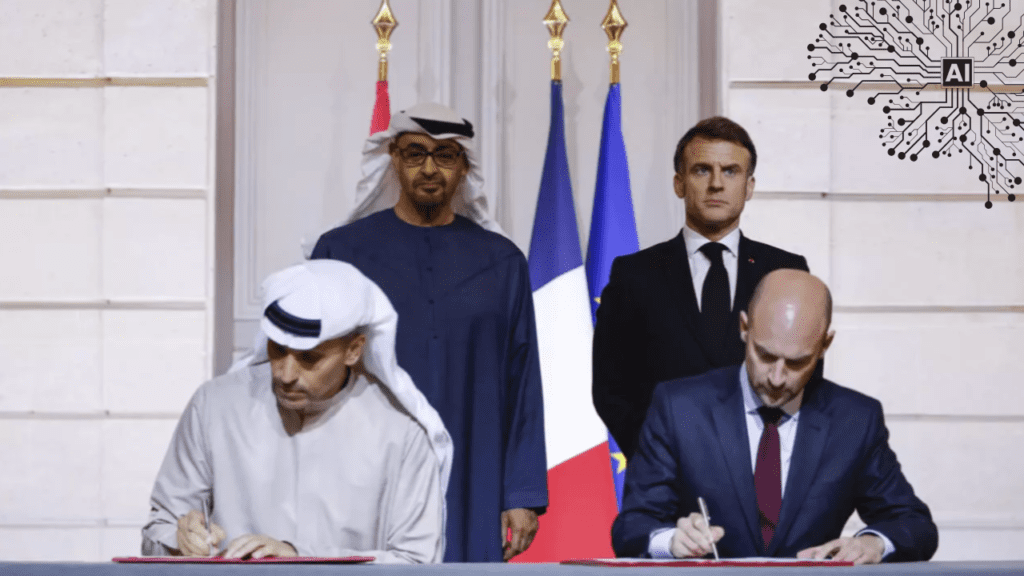
On February 6, 2025, France and the United Arab Emirates (UAE) announced a landmark €30-50 billion ($31-52 billion) partnership to build Europe’s largest AI data center, a 1-gigawatt facility in France. This collaboration, unveiled ahead of the Artificial Intelligence Action Summit in Paris (February 10-11, 2025), aims to position both nations as global AI leaders. However, such massive infrastructure projects backed by Emirati sovereign wealth funds like MGX and French tech giants like STMicroelectronics raise critical cybersecurity challenges. This article dissects the risks, geopolitical dynamics, and actionable strategies to safeguard this ambitious initiative from cyber threats.
The UAE-France AI Data Center: A Cybersecurity Deep Dive. The 1GW AI campus, part of a broader Franco-Emirati framework agreement, will focus on developing sovereign AI, cloud systems, and advanced semiconductor production. Key components include:
- Infrastructure: A data center powered by France’s nuclear energy (65% of national electricity) and renewable sources (25%).
- Strategic Partnerships: UAE’s MGX fund (investor in OpenAI’s $500B Stargate project) and France’s Mistral.AI (a leading European LLM developer) are central players.
- Geopolitical Drivers: The UAE seeks to reduce reliance on U.S. chip exports amid tightening Biden-era restrictions, while France aims to counterbalance U.S. and Chinese AI dominance.
Cybersecurity Risks
1. Supply Chain Vulnerabilities:
- The UAE-France semiconductor plant near Grenoble (a joint venture between Mubadala and STMicroelectronics) could become a target for nation-state actors seeking to compromise hardware integrity.
- Recent U.S. export controls on AI accelerators highlight risks of counterfeit or backdoored chips entering the supply chain.
2. AI Model Exploitation:
- Mistral.AI’s integration with Cerebras’ wafer-scale compute platform (“Flash Answers”) introduces attack surfaces for adversarial machine learning or data poisoning.
- Sovereign AI systems storing sensitive government or corporate data in “virtual data embassies” risk exposure if encryption protocols fail.
3. Critical Infrastructure Threats:
- A 1GW facility’s energy demands make it a high-value target for ransomware groups (e.g., LockBit 4.0) or state-sponsored actors aiming to disrupt national grids.
- The 2024 EDF “Project Giga” initiative—designed to power AI data centers—has already faced scrutiny over grid resilience.
4. Geopolitical Espionage:
- The UAE’s partnerships with Chinese firms like G42 and U.S. entities like Microsoft create dual-use technology risks, potentially exposing the data center to espionage by APT groups like APT41 (China) or ATP28 (Russia).
10 Cybersecurity Recommendations for Sovereign AI Infrastructure
1. Secure Semiconductor Supply Chains:
Implement hardware root of trust (RoT) protocols and third-party audits for chips produced at the Grenoble plant.
2. Adopt Zero-Trust Architectures:
Segment networks between AI training clusters, cloud storage, and external APIs to limit lateral movement.
3. Enhance AI Model Security:
Deploy runtime monitoring for LLMs like Mistral’s Le Chat to detect data poisoning or model inversion attacks.
4. Strengthen Grid Resilience:
Collaborate with EDF to isolate the data center’s power supply from public grids, reducing susceptibility to wiper malware.
5. Leverage Nuclear Energy’s Security Benefits:
France’s nuclear reliance offers inherent redundancy; replicate this with microgrids for backup during cyber-physical attacks.
6. Establish Virtual Data Embassy Protections:
Use quantum-resistant encryption and air-gapped backups for sovereign AI datasets stored in cross-border “embassies”.
7. Monitor Third-Party Code:
Scrutinize open-source libraries (e.g., PyTorch) integrated into AI workflows for vulnerabilities like Log4j-style exploits.
8. Conduct Red-Teaming Exercises:
Simulate APT attacks on the AI campus’s HVAC and cooling systems, which are often overlooked entry points.
9. Align with EU Regulations:
Ensure compliance with the AI Act’s transparency mandates and GDPR’s data localization requirements.
10. Foster Public-Private Threat Intelligence Sharing:
Join Europol’s EC3 and UAE’s National Cybersecurity Council to exchange IoCs related to AI-targeting malware.
Conclusion: Balancing Innovation and Cyber Resilience
The UAE-France AI data center represents a bold leap into the future of sovereign technology but also underscores the fragility of interconnected, high-stakes infrastructure. With cybercrime costs projected to reach $13 trillion globally by 2026, proactive measures—from securing semiconductor supply chains to adopting zero-trust frameworks—are non-negotiable.
As global leaders convene at the Paris AI Summit, cybersecurity must remain central to discussions. The Franco-Emirati partnership could set a precedent for secure, sustainable AI development—but only if both nations prioritize resilience over rapid deployment. For cybersecurity professionals, this project is a call to action: innovate relentlessly, but never at the expense of vigilance.
Want to stay on top of cybersecurity news? Follow us on Facebook, X (Twitter), Instagram, LinkedIn and YouTube for the latest threats, insights, and updates!