


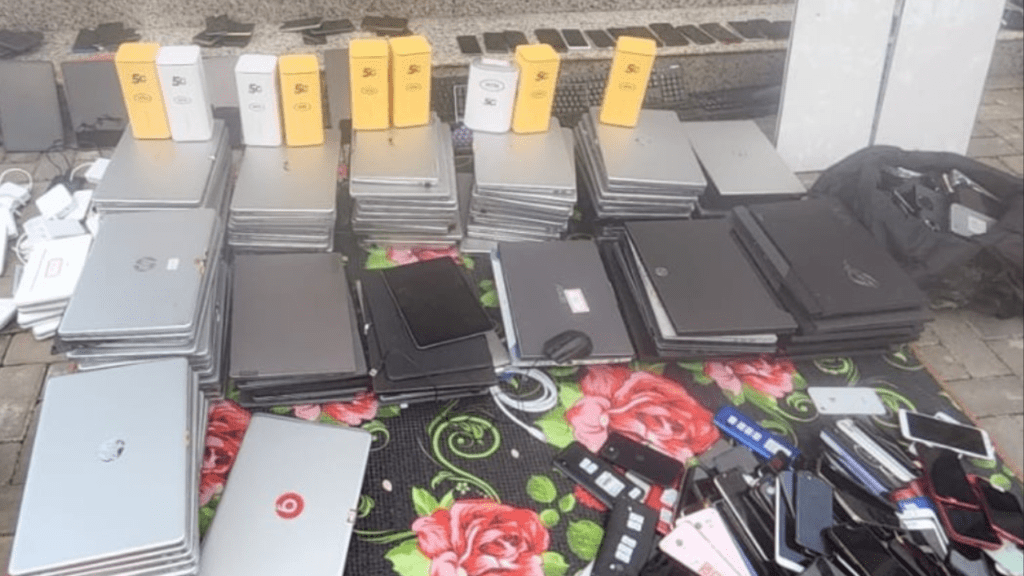
In a sweeping four-month operation spanning November 2024 to February 2025, African law enforcement agencies, coordinated by INTERPOL, arrested 306 suspects and seized 1,842 devices linked to cybercrime syndicates targeting banking, investment, and messaging app scams. Dubbed Operation Red Card, this multinational effort involved seven African nations Benin, Côte d’Ivoire, Nigeria, Rwanda, South Africa, Togo, and Zambia and uncovered over 5,000 victims of cyber-enabled fraud.
The operation marks a pivotal shift in Africa’s cybersecurity posture, combining cross-border collaboration, private-sector intelligence, and aggressive asset forfeiture to disrupt criminal ecosystems.
Detailed Breakdown of Operation Red Card
1. Scope and Coordination
Operation Red Card focused on dismantling cross-border cybercrime networks exploiting mobile banking, phishing, and social engineering scams. INTERPOL’s Cybercrime Directorate spearheaded intelligence sharing, leveraging data from cybersecurity firms Group-IB, Kaspersky, and Trend Micro to identify criminal methodologies. Key tactics included:
- SIM Box Fraud: Rerouting international calls to bypass telecom fees, enabling mass SMS phishing.
- Malware-Enabled Account Takeovers: Infecting devices via malicious links to hijack banking apps.
- Social Engineering: Impersonating telco employees or family members to extract sensitive data.
2. Country-Specific Takedowns
Nigeria: The Hub of Cyber-Enabled Scams
- Arrests: 130 suspects, including 113 foreign nationals from West Africa and Southeast Asia.
- Schemes: Online casino fraud, fake investment platforms, and human trafficking-linked operations.
- Seizures: 26 vehicles, 16 houses, 39 plots of land, and 685 devices.
- Human Trafficking Angle: Nigerian authorities revealed that some suspects were coerced into running scams, highlighting ties to organized crime.
South Africa: SIM Box Fraud Nexus
- Arrests: 40 individuals linked to a SIM box network.
- Seizures: 1,000+ SIM cards, 53 desktops.
- Impact: The network facilitated SMS phishing attacks impersonating banks and government agencies.
Zambia: Malware-Driven Banking Fraud
- Arrests: 14 suspects in a syndicate spreading malware via WhatsApp.
- Method: Victims received messages with malicious links that installed malware, granting hackers control over devices and banking apps.
Rwanda: Social Engineering Epidemic
- Arrests: 45 criminals posing as telecom staff or family members.
- Losses: $305,000 stolen in 2024 through fake “jackpot” scams and fabricated emergencies.
- Recovery: $103,043 reclaimed, 292 devices seized.
3. Private Sector and International Collaboration
INTERPOL’s Neal Jetton, Director of Cybercrime, emphasized the role of public-private partnerships:
“The integration of threat intelligence from Group-IB and Trend Micro allowed us to map criminal infrastructures and tactics in real-time. This operation proves that global collaboration is non-negotiable in combating borderless cybercrime.”
10 Critical Strategies to Mitigate Similar Threats
- Deploy Multi-Factor Authentication (MFA): Mandate MFA for all banking and messaging apps.
- Block SIM Box Traffic: Partner with telecom providers to flag spoofed numbers.
- Educate Employees and Customers: Train staff to recognize phishing lures (e.g., fake “jackpot” alerts).
- Monitor Dark Web Activity: Use services like Group-IB to track stolen data dumps.
- Segment Networks: Isolate critical systems from guest devices to limit malware spread.
- Adopt Zero-Trust Frameworks: Verify all users and devices before granting access.
- Update Incident Response Plans: Include protocols for SIM swap fraud and account takeovers.
- Leverage AI-Driven Threat Detection: Deploy tools like Trend Micro’s XDR to identify anomalous behavior.
- Strengthen International Cooperation: Share IoCs (Indicators of Compromise) via INTERPOL’s I-24/7 system.
- Audit Third-Party Vendors: Ensure partners comply with cybersecurity standards like ISO 27001.
The Bigger Picture: Africa’s Cybersecurity Awakening
Operation Red Card underscores Africa’s escalating fight against cybercrime, which costs the continent an estimated $4.1 billion annually (Cybersecurity Ventures, 2024). Challenges persist:
- Resource Gaps: Limited cybersecurity budgets in nations like Benin and Togo.
- Ransomware Surge: Attacks on African enterprises rose by 62% in 2024 (Interpol).
- Human Trafficking Links: Cybercrime syndicates increasingly exploit vulnerable populations.
Yet, successes like Nigeria’s asset seizures and Rwanda’s fund recovery signal progress. As Abimbola Shukurat Bakare, Nigeria’s Cybercrime Prosecutor, noted:
“We’re shifting from reactive arrests to proactive dismantling of criminal economies—hitting them where it hurts: their wallets.”
Conclusion
Operation Red Card is a watershed moment for African cybersecurity, demonstrating the power of cross-border collaboration and intelligence-led policing. For cybersecurity professionals, the operation offers key lessons: prioritize threat intelligence sharing, invest in employee education, and advocate for stricter regulations on SIM card sales and digital asset tracing.
As cybercriminals evolve, so must defenses. Sub-Saharan Africa’s journey from cybercrime hotspot to regional enforcement leader is just beginning—and the world is watching.