


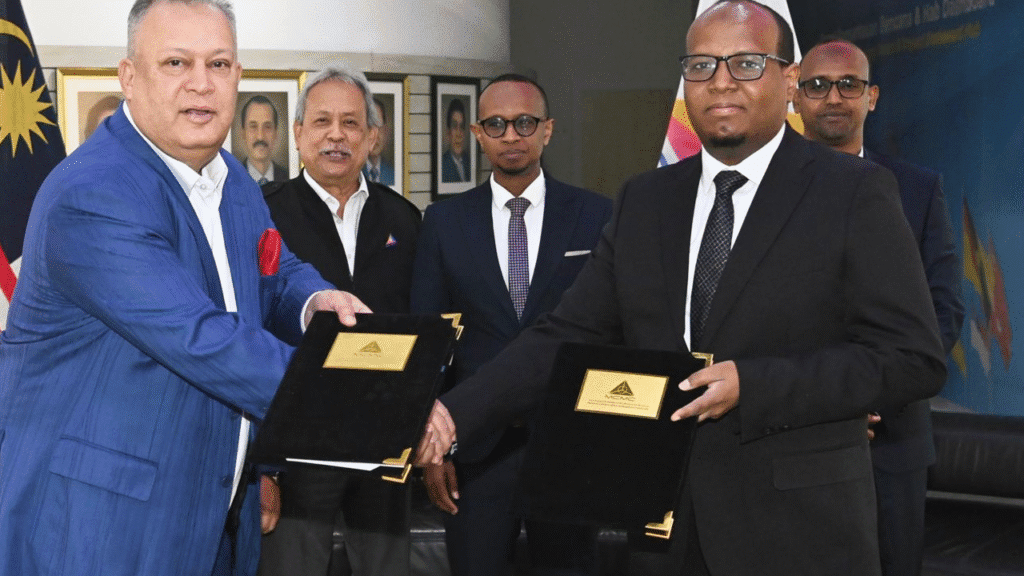
Cyberjaya, Malaysia – 7 May 2025 – Somalia has signed two significant Memoranda of Understanding (MOUs) with Malaysia to strengthen its digital regulation capabilities and fortify its national cybersecurity posture. These agreements mark a pivotal step in Somalia’s digital transformation strategy and underscore growing cooperation between African and Asian nations in addressing global cyber threats and regulatory modernization.
Twin MOUs with Malaysian Authorities: A Milestone for Somalia’s Digital Future
On 7 May 2025, the National Communications Authority (NCA) of Somalia formalized two collaborative agreements in Cyberjaya, Malaysia, with the Malaysian Communications and Multimedia Commission (MCMC) and CyberSecurity Malaysia.
The first MOU, signed between NCA and MCMC, is geared toward:
- Strengthening cooperation on 5G frameworks and digital infrastructure policy.
- Promoting regulatory best practices through mutual learning.
- Enhancing institutional capacity building across both nations’ communications sectors.
The second agreement, signed with CyberSecurity Malaysia, zeroes in on:
- Joint response strategies for cyber incidents.
- Sharing of threat intelligence, technical trends, and cybersecurity best practices.
- Collaborative programs in certification, cyber diplomacy, and Somalia’s participation in the Global ACE Country Chapter.
Official Endorsements: Emphasizing Mutual Growth and Threat Preparedness
At the ceremony with MCMC, YBhg. Tan Sri Mohamad Salim bin Fateh Din, Chairman of MCMC, stated:
“International partnerships are essential to advance regulatory excellence. This MOU establishes a framework for sustained engagement, experience sharing, and capacity development between our institutions.”
Mr. Mustafa Yaasin Sheik, Director General of Somalia’s NCA, hailed the agreement as “timely and practical,” emphasizing that the partnership would accelerate Somalia’s digital transformation and deepen its institutional expertise.
In a separate ceremony with CyberSecurity Malaysia, Dato’ Ts. Dr. Haji Amirudin Bin Abdul Wahab, CEO of the agency, said:
“This partnership enhances our collective resilience against sophisticated and emerging cyber threats. Together, we will build proactive defenses and exchange vital intelligence.”
Mr. Sheik added:
“CyberSecurity Malaysia’s willingness to collaborate is critical for Somalia’s cyber readiness journey. These joint initiatives are not only strategic but vital to securing our digital future.”
Africa-Asia Tech Diplomacy: A Growing Trend
This partnership reflects a growing geopolitical shift: African nations are increasingly looking East for technical expertise and cybersecurity collaboration. Somalia’s strategic outreach to Malaysia follows similar recent MOUs signed by Ghana, Kenya, and Nigeria with partners in Singapore, India, and South Korea.
The MEA (Middle East and Africa) region continues to face a rise in cybercrime. According to Interpol’s 2024 African Cyberthreat Assessment Report (Oct 2024), ransomware and business email compromise (BEC) attacks surged by 29% year-on-year in Africa. Somalia’s national cyber strategy, launched in December 2023, specifically cited the need for foreign partnerships to mitigate capability gaps and strengthen cyber deterrence.
Why This Matters Globally
With Somalia’s digital economy projected to grow by 19% annually through 2030 (African Development Bank, Jan 2025), these MOUs signal a proactive stance to ensure regulatory maturity and threat resilience.
Malaysia, on the other hand, has established itself as a regional cybersecurity hub in Southeast Asia. CyberSecurity Malaysia operates under the Ministry of Science, Technology and Innovation (MOSTI) and provides regional leadership in incident response, national cyber drills, and certification.
By aligning with a recognized cybersecurity powerhouse, Somalia ensures access to proven methodologies, technical toolkits, and operational playbooks for managing digital risk.
Regional and Global Implications
For Africa:
- Boosts pan-African cyber alliances.
- Somalia becomes the first East African nation to engage CyberSecurity Malaysia formally.
- Enhances NCA’s standing within Smart Africa and African Union digital policy dialogues.
For Asia:
- Reinforces Malaysia’s diplomatic tech outreach and ASEAN-Africa cybersecurity frameworks.
- Encourages Malaysian firms to explore investment opportunities in Africa’s untapped telecom and digital service markets.
Globally:
- Supports UN SDG Goals 9 and 16 (industry innovation and strong institutions).
- Reinforces a South-South cooperation model for cyber capacity building.
- Creates a precedent for multi-regional alignment on cybersecurity regulations and digital governance.
Actionable Takeaways for Cybersecurity Leaders
- Establish bilateral and multilateral MOUs to fast-track digital resilience initiatives.
- Invest in regulatory capacity building through knowledge-sharing partnerships.
- Collaborate on cyber diplomacy frameworks to unify incident response approaches.
- Adopt cross-border certification schemes to validate technical competencies.
- Integrate regional threat intelligence sharing into national CERT operations.
- Benchmark policies against international partners for continual improvement.
- Align 5G and digital infrastructure development with global standards.
- Educate policymakers on cybersecurity legislation through peer learning.
- Create exchange programs for cybersecurity professionals across regions.
- Participate in global alliances like the Global ACE Chapter to enhance collective security posture.
Conclusion: A Blueprint for Emerging Nations
Somalia’s dual agreements with Malaysian authorities underscore a strategic pivot toward international cybersecurity cooperation and regulatory modernization. These MOUs serve as a blueprint for other developing countries looking to bolster national cyber resilience, harmonize digital regulations, and leverage international best practices to combat evolving threats. As cyber risks grow more global and interconnected, partnerships like these offer both a safeguard and a stepping stone to a secure digital future.
Source
- Somalia NCA official press release (7 May 2025)
- Malaysian Communications and Multimedia Commission (MCMC)
- CyberSecurity Malaysia
- Interpol African Cyberthreat Assessment Report (Oct 2024)
- African Development Bank Digital Economy Outlook (Jan 2025)
- United Nations Sustainable Development Goals
- Smart Africa Alliance
- Global ACE Scheme Overview
- MOSTI – Malaysia’s Ministry of Science, Technology and Innovation
- CyberCory.com – Cybersecurity News, Updates, Alerts and Best Practices