

Microsoft 365 service disruptions can quickly become business-wide problems. When Outlook stops delivering email or Microsoft Teams becomes unreliable, the impact reaches far beyond individual users. Meetings are interrupted, customer communications are delayed, internal approvals stall and organizations that depend heavily on Microsoft’s cloud ecosystem can find themselves struggling to maintain normal operations.
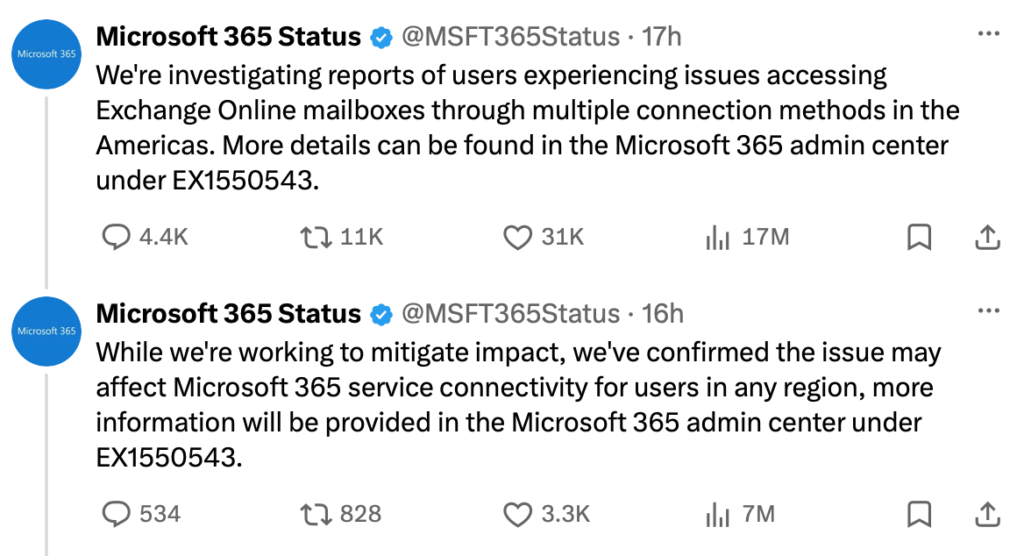
Reports on November 13, 2026, point to disruption affecting Microsoft services, including Outlook, with users reporting problems accessing or using their email. Microsoft 365’s official service-status account has been communicating updates while the company investigates the reported issues.
The incident is another reminder that even the world’s largest cloud platforms are not immune to service interruptions. For organizations that rely on Microsoft 365 for daily operations, the immediate concern is restoring productivity. The longer-term question is whether their business continuity arrangements are strong enough to keep essential operations running when a major cloud service becomes unavailable.
What Is Actually Happening Inside Microsoft?
The disruption is centred on Exchange Online, Microsoft’s cloud-based email platform, but its effects have extended into other Microsoft 365 services.
Microsoft’s service incident reports identify two related incidents:
- EX1550543: Users may be unable to connect to their Exchange Online mailboxes through multiple connection methods.
- MO1550821: Users may be unable to connect to multiple Microsoft 365 services.
The Exchange Online incident began at approximately 16:17 UTC on November 12, 2026. Microsoft subsequently confirmed that the problem was affecting Outlook on the web, Outlook desktop, Exchange ActiveSync and REST-based connections. Email delivery could also be delayed.
The wider Microsoft 365 disruption has affected several services and features that depend on Exchange Online, including:
- Outlook and Exchange Online email.
- Microsoft Teams calendar, meeting scheduling and certain chat functions.
- Microsoft Copilot Chat and access to work data.
- Microsoft 365 administration portals.
- Microsoft Planner and Microsoft To Do.
- Microsoft Defender for Office 365 Safe Links.
- Microsoft Defender XDR portal access.
- Microsoft Purview features, including data loss prevention and classification.
- Microsoft Graph API requests involving email, calendars and contacts.
- Certain Microsoft Fabric, SharePoint and Power BI functions.
An important distinction is that not every feature of these products has stopped working. Microsoft has indicated that functions independent of Exchange Online may remain available. For example, direct access to files stored in SharePoint can continue even when certain connected features are disrupted.
This dependency is particularly important for IT administrators. An organization may experience problems with security portals, administrative functions and collaboration workflows even when its underlying network and internet connectivity are operating normally.
Microsoft’s Explanation: Infrastructure Instability, Not a Confirmed Cyberattack
One of the first questions raised during a major technology outage is whether it is the result of a cyberattack.
In this case, Microsoft has stated that it is not aware of malicious activity causing the incident.
Its investigation initially identified elevated infrastructure load across multiple regions. The company later explained that the increased load was not necessarily caused by a sudden increase in user traffic, but by servers becoming unexpectedly unavailable.
Microsoft’s investigation also identified a problem involving a process responsible for establishing secure connections. On affected servers, that process became overwhelmed, preventing the infrastructure from processing requests properly.
The company began testing configuration changes, restarting affected servers, redistributing traffic and reviewing recent network configuration changes.
However, recovery proved more complicated than expected.
Some servers initially returned to service but became unresponsive again when traffic was redirected to them. Microsoft therefore introduced additional traffic-management controls, tested alternative configurations and began expanding infrastructure capacity through virtual machines.
In its November 13 updates, the company reported positive signs of server stability after applying an upstream authentication and routing configuration patch to part of its infrastructure. It was working to extend the changes to additional servers and regions.
Editorial distinction: Microsoft has not established a final root cause in the information reviewed for this article. The possibility of a problematic configuration or infrastructure change should not be presented as a confirmed cause.

The Global Impact: From Corporate Email to Government Operations
The outage has demonstrated how deeply Microsoft 365 is embedded in the daily operations of businesses and public institutions.
According to the Associated Press, Downdetector recorded approximately 130,000 reports of Outlook problems from users across dozens of countries at the peak of the disruption. Reports subsequently declined, although problems continued for many customers. AP News
The consequences have extended well beyond individual users.
United States: Government departments and businesses reported problems accessing email and Microsoft applications. Workhorse Group, an industrial technology company, postponed an earnings call because of the disruption.
Singapore: The Government Technology Agency reported that government email services were unavailable, affecting official communications.
Philippines: The Supreme Court reported that the incident had affected some operations, including responses to emails.
Japan: Government IT infrastructure was affected, prompting authorities to monitor the situation and prepare alternative communication methods.
Hong Kong: Businesses reported difficulties receiving communications from international customers. Some banking operations were also disrupted.
India: IndiGo reported disruption to its email support services, affecting its ability to receive customer enquiries. Air India temporarily rerouted email services to maintain customer communications while confirming that its flight operations were unaffected. AP News+1
The incident also affected organizations working with Microsoft 365 integrations. OpenAI and Anthropic reported connectivity problems involving Microsoft 365 tools, illustrating how disruption to one cloud ecosystem can affect other technology providers that depend on its services. AP News
What About the Middle East and Africa?
For businesses across the Middle East and Africa, the incident is particularly relevant because Microsoft 365 is widely used for corporate communication, collaboration, identity management and security administration.
In the UAE, Gulf News reported disruption affecting users in the country, with Outlook, Teams and other Microsoft 365 services appearing among the most reported problems on Downdetector’s UAE platform.
The outage also demonstrates why regional businesses should not assume that using a globally distributed cloud platform automatically guarantees uninterrupted access to every service. Gulf News+1
Consider a Dubai-based company with operations in Saudi Arabia, Kenya, Nigeria and South Africa. Its employees may use Outlook for customer communication, Teams for internal coordination, SharePoint for documentation and Microsoft Entra ID for identity management.
If several connected services become unavailable simultaneously, the business could face difficulties in:
- Communicating with customers and suppliers.
- Processing purchase orders and approvals.
- Coordinating international teams.
- Accessing security and compliance dashboards.
- Responding to incidents and operational emergencies.
- Managing customer support requests.
For financial institutions, healthcare providers, government agencies and critical infrastructure operators, such disruption can have consequences beyond lost productivity.
It is also a reminder for organizations subject to regulatory and operational resilience requirements to understand how their cloud service dependencies affect business continuity.
The Bigger Issue: Cloud Concentration and Business Continuity
The Microsoft outage raises a question that every IT director and CISO should be asking: what happens when a technology provider supporting several critical business functions becomes unavailable?
For many organizations, Microsoft 365 is no longer simply an email subscription. It has become part of the operational backbone.
Email, identity, collaboration, file sharing, endpoint management, security monitoring and compliance workflows increasingly operate within interconnected cloud environments.
This creates efficiency, but it also introduces concentration risk.
A disruption affecting one underlying service can create a chain reaction across multiple applications. The resulting impact may be disproportionate to the original technical problem.
The comparison with the July 2024 CrowdStrike incident is understandable, particularly because both events demonstrated the potential consequences of disruption to widely deployed technology infrastructure. However, the two incidents should not be treated as technically identical.
Australian Home Affairs Minister Tony Burke said Microsoft had described the current incident as potentially similar in some respects to the 2024 outage, involving an update that had gone wrong rather than a cyberattack. That remains an attributed comparison, not a confirmed technical explanation of Microsoft’s current outage. AP News
The lesson for organizations is not to abandon cloud services. It is to avoid building business continuity plans around the assumption that a single provider will always be available.
Ten Actions IT and Security Teams Should Take
A major cloud outage is a useful test of an organization’s resilience. IT departments should use this incident to review their ability to maintain operations when critical SaaS services become unavailable.
Here are ten practical recommendations.
1. Establish an independent communication channel.
Maintain alternative communication methods that do not depend on Microsoft 365. This could include a separate business messaging platform, emergency telephone lists and an independent incident communication channel.
2. Develop a documented business continuity plan.
Identify which departments and business processes depend on Outlook, Teams, SharePoint, Entra ID and other Microsoft services. Define how each critical activity will continue during an outage.
3. Monitor Microsoft’s official service health updates.
IT administrators should monitor the Microsoft 365 admin centre and official service-status communications. Use independent outage-monitoring services as additional indicators, not as replacements for Microsoft’s incident information.
4. Maintain independent access to critical documentation.
Ensure that essential emergency procedures, business contacts, recovery instructions and operational documents can be accessed through approved alternatives when Microsoft 365 is unavailable.
5. Review email continuity and recovery arrangements.
Assess whether your organization can maintain essential inbound and outbound email communications during an Exchange Online disruption. Review email continuity solutions, mail-flow dependencies and procedures for handling delayed messages.
6. Protect backups independently of Microsoft 365 availability.
Maintain tested backups of business-critical Microsoft 365 data, including Exchange Online, SharePoint and OneDrive. Ensure that backup infrastructure and recovery documentation do not depend entirely on the same cloud services being protected.
7. Test alternative identity and administrative access procedures.
Review emergency access accounts, privileged access arrangements and procedures for managing critical systems when normal cloud identity or administration functions become unavailable. Keep emergency credentials protected and controlled.
8. Review third-party dependencies.
Map the applications, APIs and business processes that depend on Microsoft Graph, Exchange Online and other Microsoft services. Identify which third-party platforms will also become unavailable during a Microsoft 365 disruption.
9. Introduce regular outage simulations.
Run tabletop exercises involving IT, cybersecurity, operations, communications, legal and executive management. Simulate the loss of email, collaboration tools or cloud identity services and evaluate how quickly the organization can maintain essential operations.
10. Train employees and strengthen incident awareness.
Employees should understand how to report service disruptions, identify legitimate alternative communication channels and avoid phishing attempts that exploit confusion during outages. Invest in regular cybersecurity training and awareness to strengthen organizational readiness.
These measures should be part of a broader cybersecurity and business resilience strategy, rather than activities introduced only after a major service interruption.
A Separate Security Advisory: Veeam CVE-2026-98432
There is another important security development worth distinguishing from the Microsoft outage.
Veeam’s Knowledge Base article KB4966, published on November 6 and updated November 12, addresses CVE-2026-98432, a Linux kernel use-after-free vulnerability with a CVSS score of 9.8.
The vulnerability affects certain Veeam components that include a Linux kernel, including Veeam Software Appliance 13.1 and Infrastructure Appliance 13.1, until the relevant kernel update is installed.
Veeam states that fixes are available through Veeam Updater or private fixes, depending on the affected product. Veeam Kasten for Kubernetes is listed as not affected because its container images do not include a Linux kernel. Veeam Software
This vulnerability is not identified as the cause of the Microsoft 365 outage. However, it is relevant to organizations reviewing the resilience and security of their backup infrastructure.
Backup systems are critical during cloud disruptions and cyber incidents. Security teams should ensure that their recovery platforms are themselves properly patched and protected.
See the official Veeam CVE-2026-98432 advisory for affected products and remediation instructions.
Final Thoughts: The Internet Is Connected, but Business Continuity Must Be Independent
The November 2026 Microsoft 365 outage is another reminder that even highly sophisticated cloud platforms can experience disruptions with consequences across countries, industries and government operations.
Microsoft’s infrastructure teams are working to restore services, and the company has reported improvements. However, the incident has exposed how dependent modern organizations have become on a relatively small number of cloud platforms.
For CISOs, IT directors and business leaders, the priority should be clear: cloud adoption must go hand in hand with resilience planning.
Having Microsoft 365, a backup subscription or a disaster recovery contract does not automatically mean a business can continue operating when its primary services become unavailable.
Organizations need tested alternatives, independent communication channels, accessible backups and clear recovery procedures.
The next major cloud disruption may affect a different provider or a different technology. The organizations best prepared will be those that have already planned for that possibility.
Stay informed. Stay secure.
Frequently Asked Questions
1. Is Microsoft Outlook down on November 13, 2026?
Microsoft has reported a major Exchange Online service disruption affecting Outlook access and email delivery. Recovery has been gradual, with service availability varying across regions.
2. Is Microsoft Teams affected?
Yes. Some Teams features that depend on Exchange Online, including calendar access, meeting scheduling and certain chat functions, have been affected. Not all Teams functionality has necessarily been unavailable.
3. What caused the Microsoft 365 outage?
Microsoft identified infrastructure instability, elevated load and problems involving affected servers and their secure connection processes. The company has stated that it is not aware of malicious activity causing the incident. A complete root-cause report remains pending.
4. Was this a cyberattack?
Microsoft has stated that it has no indication of malicious activity causing the outage. There is currently no verified evidence that this incident resulted from a cyberattack.
5. Are Microsoft 365 users in the UAE affected?
Yes. Users in the UAE have reported disruption involving Outlook, Teams and other Microsoft 365 services.
6. Are emails permanently lost during the outage?
Not necessarily. Microsoft has described delayed email delivery and extended its email timeout window to 48 hours to help protect delayed messages while queue processing continues. Organizations should nevertheless verify their mail-flow status and confirm that important communications have been delivered.
7. What should businesses do during a Microsoft 365 outage?
Use alternative communication channels, monitor official service updates, activate business continuity procedures and avoid making unnecessary configuration changes while Microsoft investigates the incident.